

Mount Everest Expedition (Climb Mount Everest / Sagarmatha)
Overview
Touring in Nepal, can be done all year. But the best season are Spring (March – May) and Autumn (mid Sept. – mid Dec.). Trekking in autumn season is noted for clear weather with blue sky. It gets colder towards the end of December. This trek can be done in any month with less focus on January and February as this month’s are colder than usual.
Mount Everest expedition
The Mount Everest Expedition provides you the excellent views of many mountains of Khumbu region like: Mt. Annapurna, Fishtail, Amadablam and many more. Along with this you can get the great chance to explore the Mongolian culture of Himalayan region.
Mount Everest is still the ultimate mountaineering adventure. As the highest mountain in the world, Everest has immense appeal to mountaineers and fascination for non-climbers to do amazing expedition adventure, but it also has tremendous allure because of its position in Nepal's Khumbu, one of the world's most beautiful mountain regions, and because of its remarkable climbing history.An attempt on Mt Everest is also a major undertaking which requires significant climbing experience, solid alpine skills, good mountain judgment, excellent physical conditioning, and a huge amount of dedication and determination.
We climb Everest via the South Col route from Nepal in the spring season because this route and timing offer the absolute best chance of success. Therefore routes from the north are technically more difficult, especially high on the mountain, and in the spring climbing season. We gain the dual advantages of getting progressively milder weather as we move closer to the summit. Next, climbing more stable slopes because the winter winds have scoured away much of the snow, significantly reducing the avalanche hazard.
Are you doing Mt. Everest expedition ?
Mount Everest expedition is a joint adventure expedition we do well undertaking. The Institute has the most extensive and successful high altitude guiding record in the world, and has the highest success rate guiding on Mt. Everest (with many climbers reaching the summit). Both companies are committed to meticulous preparation. Similarly our expert Sherpas and support staff, to careful menu planning, oxygen support, satellite communication, environmental protection, and a mountain clean-up plan, our expedition is finely tuned to Leave No Trace while offering you the highest possible chances for success
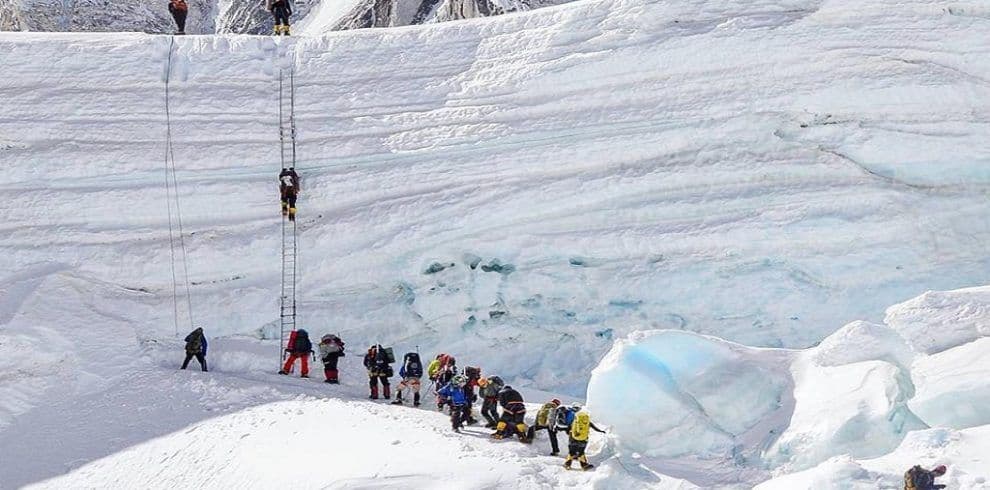
However, by the time you arrive at the base camp at the foot of the Khumbu Icefall, a route will already be established with ropes and ladders through the ice fall to Camp 1, and our strong Sherpa team will be ferrying loads of equipment up the mountain. On your first acclimatization foray, you'll spend several days at and above Camp 2. On your second foray, you'll spend several days and nights at Camp 3, and on your summit attempt, we will climb through the established camps with lightweight packs to Camp 4 on the South Col. All climbers will be sleeping on bottled oxygen before setting out for the summit, carrying only very lightweight oxygen bottles.
Finally, Everest expedition will be organized in such a way to allow members to concentrate largely on their own health and performance, without the burden of load carrying or dealing with logistics. A doctor, who is experienced in high altitude medicine, will be resident at base camp throughout the expedition to monitor your acclimatization and provide for your health care. So,Please see our web site for more details on all these expeditions or call us to discuss our high altitude program.
What‘s Included
What‘s Excluded
Availability
Select your preferred departure date. Trip duration: 19 days
| Su | Mo | Tu | We | Th | Fr | Sa |
|---|---|---|---|---|---|---|
| Su | Mo | Tu | We | Th | Fr | Sa |
|---|---|---|---|---|---|---|
Number of Travellers
Select a date to book
Dates are subject to availability. Please contact us to confirm your preferred dates.
Itinerary
Arrival in Kathmandu airport, meet our staff then transfer to Hotel.
Preparation for Expedition.
Official works for expedition and briefing by officer of Ministry of Tourism.
Fly to Lukla 2860m. then trek to Phakding 2622m. /Manjo
Phakding/Manjo – Namche 3440m.
Rest day for acclimatization and explore around.
Namche – Tengboche 3867m.
Tengboche – Dingboche 4343m.
Dingboche – Labuche 4915m.
Lobuche – Everest Base Camp 5380m.
Climbing Period for Mt. Everest 8,848m. (Base to Base)
Cleaning Base Camp and Preparation.
Base Camp – Pheriche.
Pheriche – Tengboche.
Tengboche – Namche Bazaar.
Namche Bazaar – Lukla and transfer to Teahouse Lodge.
Flight back to Kathmandu then transfer to Hotel.
Free in Kathmandu.
Last minute, transfer to airport for your onward journey.
FAQs about
the trip
Nepal, as a tourist destination is good for all seasons, however, the best seasons for trekking to Kanchenjunga region are Spring (March – May) and Autumn (mid Sept. – mid Dec. ). Trekking in autumn season is noted for clear weather and excellent views of silvery mountains against blue sky. It gets colder towards the end of December. This trek can be done in any month except January and February.
Nepal, as a tourist destination is good for all seasons, however, the best seasons for trekking to Kanchenjunga region are Spring (March – May) and Autumn (mid Sept. – mid Dec. ). Trekking in autumn season is noted for clear weather and excellent views of silvery mountains against blue sky. It gets colder towards the end of December. This trek can be done in any month except January and February.
Nepal, as a tourist destination is good for all seasons, however, the best seasons for trekking to Kanchenjunga region are Spring (March – May) and Autumn (mid Sept. – mid Dec. ). Trekking in autumn season is noted for clear weather and excellent views of silvery mountains against blue sky. It gets colder towards the end of December. This trek can be done in any month except January and February.
Nepal, as a tourist destination is good for all seasons, however, the best seasons for trekking to Kanchenjunga region are Spring (March – May) and Autumn (mid Sept. – mid Dec. ). Trekking in autumn season is noted for clear weather and excellent views of silvery mountains against blue sky. It gets colder towards the end of December. This trek can be done in any month except January and February.
Nepal, as a tourist destination is good for all seasons, however, the best seasons for trekking to Kanchenjunga region are Spring (March – May) and Autumn (mid Sept. – mid Dec. ). Trekking in autumn season is noted for clear weather and excellent views of silvery mountains against blue sky. It gets colder towards the end of December. This trek can be done in any month except January and February.
Nepal, as a tourist destination is good for all seasons, however, the best seasons for trekking to Kanchenjunga region are Spring (March – May) and Autumn (mid Sept. – mid Dec. ). Trekking in autumn season is noted for clear weather and excellent views of silvery mountains against blue sky. It gets colder towards the end of December. This trek can be done in any month except January and February.
Nepal, as a tourist destination is good for all seasons, however, the best seasons for trekking to Kanchenjunga region are Spring (March – May) and Autumn (mid Sept. – mid Dec. ). Trekking in autumn season is noted for clear weather and excellent views of silvery mountains against blue sky. It gets colder towards the end of December. This trek can be done in any month except January and February.
Nepal, as a tourist destination is good for all seasons, however, the best seasons for trekking to Kanchenjunga region are Spring (March – May) and Autumn (mid Sept. – mid Dec. ). Trekking in autumn season is noted for clear weather and excellent views of silvery mountains against blue sky. It gets colder towards the end of December. This trek can be done in any month except January and February.
Nepal, as a tourist destination is good for all seasons, however, the best seasons for trekking to Kanchenjunga region are Spring (March – May) and Autumn (mid Sept. – mid Dec. ). Trekking in autumn season is noted for clear weather and excellent views of silvery mountains against blue sky. It gets colder towards the end of December. This trek can be done in any month except January and February.
Nepal, as a tourist destination is good for all seasons, however, the best seasons for trekking to Kanchenjunga region are Spring (March – May) and Autumn (mid Sept. – mid Dec. ). Trekking in autumn season is noted for clear weather and excellent views of silvery mountains against blue sky. It gets colder towards the end of December. This trek can be done in any month except January and February.
Nepal, as a tourist destination is good for all seasons, however, the best seasons for trekking to Kanchenjunga region are Spring (March – May) and Autumn (mid Sept. – mid Dec. ). Trekking in autumn season is noted for clear weather and excellent views of silvery mountains against blue sky. It gets colder towards the end of December. This trek can be done in any month except January and February.
Speak to an Expert
Suresh Bhandari
Leave a Reply
Your email address will not be published.